The Local Business Gold Rush: Why National Companies Are Going Hyperlocal in 2026
Published March 6, 2026
The Paradox of Going Small to Go Big
In 2024, a mid-market SaaS company selling to restaurants tried something unconventional. Instead of running a single national outbound campaign, they divided the US into 50 city-level campaigns, each with location-specific messaging, local references, and geo-targeted lists. The result: a 340% increase in reply rates and a 180% increase in pipeline generated compared to their previous national approach.
This was not an anomaly. Across B2B, the highest-performing outbound teams in 2026 have adopted hyperlocal strategies -- targeting and messaging at the city, neighborhood, or even ZIP code level. The national spray-and-pray campaign is becoming the equivalent of a billboard on a highway nobody drives.
HYPERLOCAL VS. NATIONAL OUTBOUND PERFORMANCE
Why Hyperlocal Works
1. Local Businesses Think Locally
A plumber in Phoenix does not care about industry trends nationally. They care about what is happening in the Phoenix market. When your outreach references local conditions -- "HVAC demand in the Phoenix metro is up 23% this quarter" -- you demonstrate understanding that generic national messaging cannot match.
2. Local Proof Points Are More Persuasive
Telling a Chicago restaurant owner that "500 restaurants use our platform" is less compelling than telling them "47 restaurants in the Loop use our platform." Local social proof eliminates the distance between your customer success stories and the prospect's own situation.
3. Competition Data Is Local
Every local business knows their local competitors. When you can reference their competitive landscape -- "I noticed that three other HVAC companies in your area are running Google Ads but you are not" -- you create immediate relevance. This level of competitive intelligence is only possible with local data.
4. Search and Discovery Are Local
Google Maps results, "near me" searches, and local SEO all operate at the geographic level. Businesses think about their digital presence in local terms, and your outreach should mirror this reality.
Google reports that "near me" searches have grown over 500% in the past five years. For B2B sellers targeting local businesses, this means your prospects are already thinking hyperlocally about their customer acquisition. Outreach that matches this local mindset feels natural; outreach that does not feels generic and irrelevant.
Implementing Hyperlocal Outbound
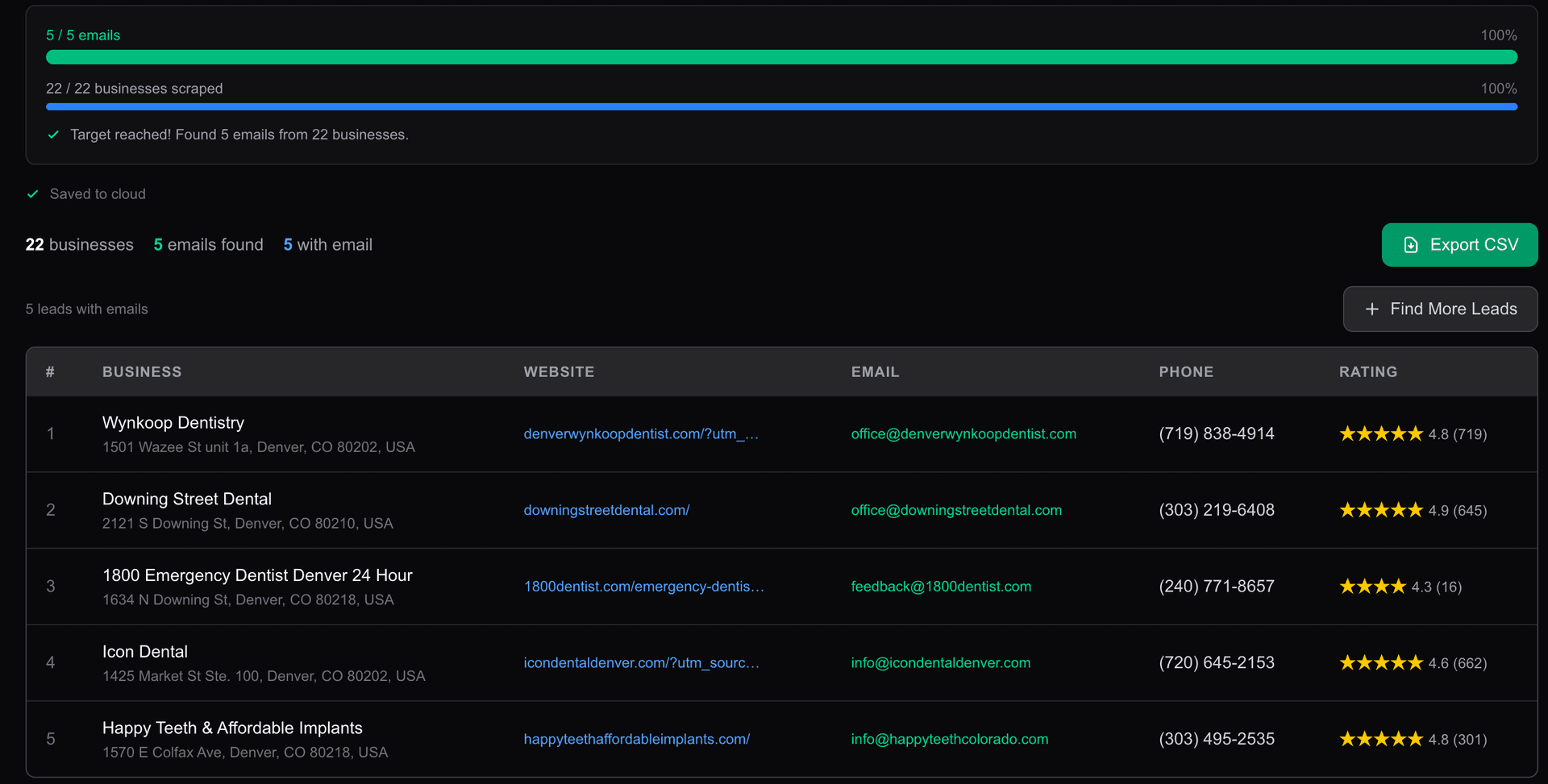
The biggest barrier to hyperlocal outbound has always been data. Building city-level prospect lists with local signal data was prohibitively time-consuming -- until tools like Easy Email Finder made it practical. By querying Google Places data for specific categories within defined geographic areas, you can build city-level prospect lists complete with local signal data (ratings, reviews, website presence) and contact information in minutes rather than days.
The hyperlocal outbound playbook:
- Select your target city: Start with markets where you already have customers or strong product-market fit
- Extract local data: Pull all businesses in your target category within the city using Easy Email Finder
- Analyze the local landscape: Understand the competitive dynamics, average ratings, and common gaps
- Craft city-specific messaging: Reference local statistics, local competitors, and local conditions
- Run concentrated campaigns: Focus your entire team on one city for 2-4 weeks before moving to the next
- Build local case studies: Convert early wins into city-specific proof points for future campaigns
The Systematic Market Expansion Model
The real power of hyperlocal outbound is its scalability through repetition. Once you prove the playbook works in City A, you replicate it in City B with minimal adaptation. Each city adds local proof points that strengthen campaigns in adjacent markets. Over 12 months, a team systematically working through 25 cities will build a national presence that feels local everywhere -- the best of both worlds.
National companies are not going hyperlocal because it is trendy. They are going hyperlocal because the data proves it works. In a world where buyers are drowning in generic outreach, the companies that show up with local knowledge and local relevance win the conversation -- and the contract.
Ready to find business emails?
Try Easy Email Finder free, get 5 credits to start.
Start Finding Emails