Google Maps Is a $0 Intent Database: How Smart Sales Teams Use It in 2026
Published March 6, 2026
The $50B Intent Data Industry Has a Free Competitor
Sales teams spent an estimated $4.2 billion on intent data platforms in 2025. Bombora, 6sense, ZoomInfo -- they all promise to tell you who is "in-market" for your solution. But here is the uncomfortable truth: the richest intent database on the planet is sitting right in front of you, completely free.
Google Maps contains over 200 million business listings worldwide. Each listing is a living, breathing signal repository -- updated by the business owners themselves, enriched by customer reviews, and validated by Google's own algorithms. And unlike traditional intent data that tells you someone visited a competitor's website three weeks ago, Google Maps signals reveal something far more actionable: the current state of a business's operations.
GOOGLE MAPS VS. TRADITIONAL INTENT DATA
The Six Intent Signals Hidden in Every Google Business Profile
Not all Google Business Profile data is created equal. Experienced sales teams have learned to decode six distinct signal categories that indicate a business's likelihood to buy:
1. Review Velocity and Sentiment
A business receiving a surge of negative reviews is a business in crisis. Crisis creates urgency, and urgency creates buyers. Conversely, a business with rapidly growing positive reviews is scaling -- and scaling businesses invest in tools to maintain growth. Both patterns are actionable.
2. Rating Gaps Within a Category
If every dentist in Austin has a 4.5+ rating except three with sub-3.5 ratings, those three businesses know they have a problem. They are already searching for solutions. Your outreach arrives as a rescue, not a cold pitch.
3. Website Quality Signals
A Google Business Profile linking to a poorly designed or non-functional website screams "underserved business." These are companies that likely lack digital sophistication across their entire operation -- making them prime candidates for SaaS, marketing services, and operational tools.
4. Incomplete Profile Data
Missing hours, no photos, empty description fields -- these are businesses that either do not understand digital presence or do not have the bandwidth to manage it. Both scenarios represent selling opportunities for the right product.
5. Category and Service Listings
Businesses that list certain service categories reveal exactly what they sell and how they position themselves. A plumber who lists "emergency plumbing" as their primary category operates differently from one listing "bathroom remodeling." Each needs different tools and services.
6. Response Patterns to Reviews
Business owners who respond to every review are engaged operators. They care about reputation, they monitor feedback, and they invest in their business. These are often the highest-converting prospects because they already demonstrate a growth mindset.
Sales teams using Google Maps data signals report 3-5x higher response rates compared to generic purchased lists. The difference is context: when you reference a prospect's actual review count, rating, or recent customer feedback in your outreach, you demonstrate relevance that no template can fake.
Building Your Intent Database from Google Maps
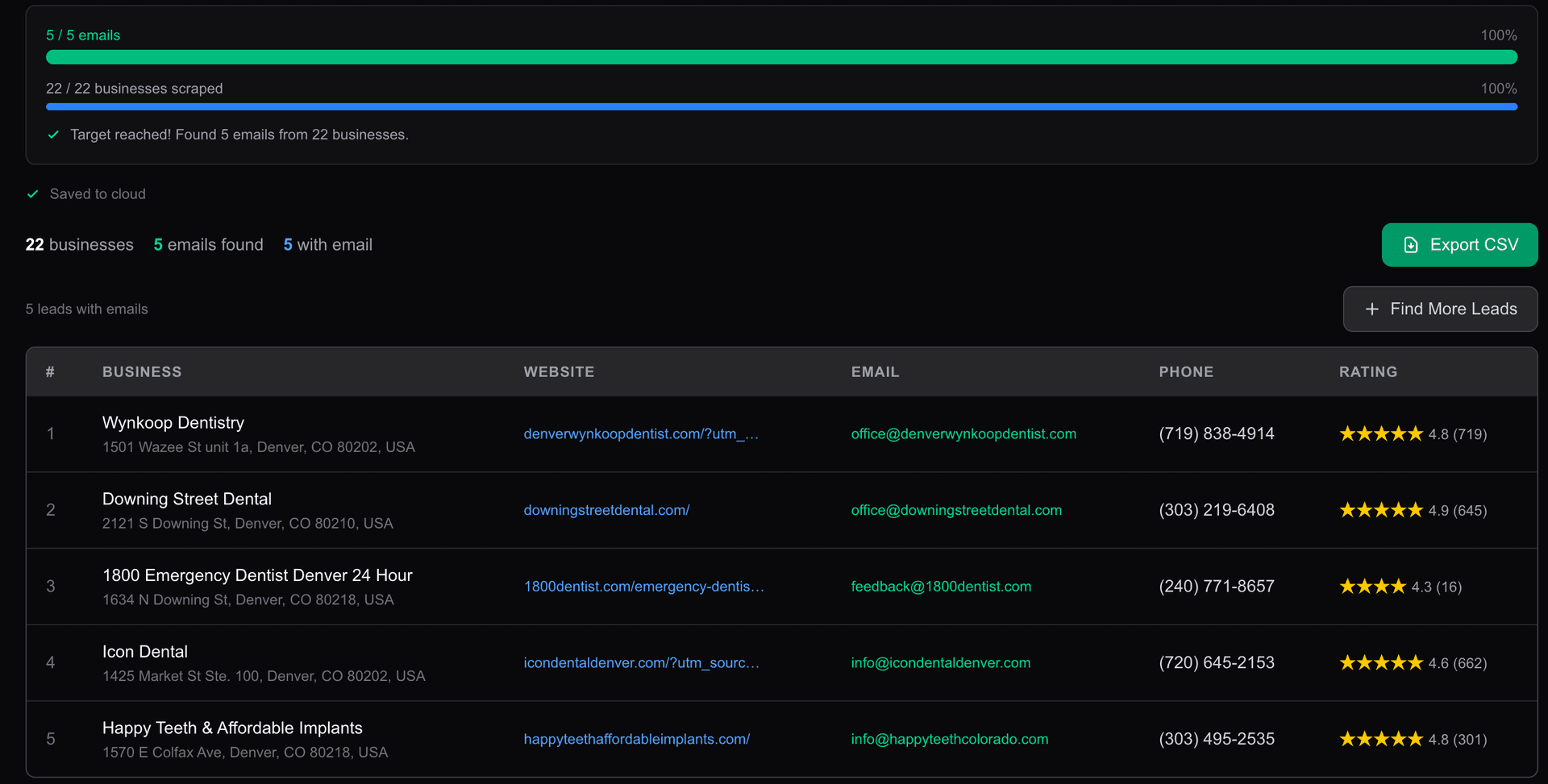
The challenge has always been scale. Manually browsing Google Maps and copying data into a spreadsheet works for 20 leads. It fails catastrophically at 2,000. This is where tools like Easy Email Finder transform the workflow. Instead of spending hours on manual extraction, you can pull structured Google Places data -- names, ratings, review counts, phone numbers, websites, and addresses -- along with verified email addresses in a single automated workflow.
The process is straightforward:
- Define your target: industry keyword + geographic area
- Extract all matching Google Business Profiles with their data points
- Filter by your intent signals (e.g., rating below 4.0, fewer than 50 reviews, no website)
- Enrich with email addresses for direct outreach
- Import into your CRM with signal data attached
The Outreach Multiplier: Signal-Informed Messaging
Raw data becomes revenue only when it shapes your messaging. Here is what signal-informed outreach looks like in practice:
Instead of: "Hi, I noticed you run a dental practice in Austin..."
You write: "Hi Dr. Martinez, I noticed your practice has 47 five-star reviews but your Google listing is missing appointment booking -- you are leaving patient conversions on the table."
That specificity is only possible when your data source includes the actual Google Business Profile signals. Tools like Easy Email Finder make this practical at scale by giving you both the signal data and the contact information in one export.
Why This Matters More in 2026
Three converging trends make Google Maps data more valuable than ever. First, traditional intent data is becoming commoditized -- when every competitor uses the same Bombora surge data, the signal loses its edge. Second, local businesses are investing more in their Google presence, making the data richer. Third, AI-powered personalization tools can now consume structured signal data and generate hyper-relevant outreach at scale.
The teams that win in 2026 are not the ones spending the most on data subscriptions. They are the ones reading signals that competitors overlook -- and the biggest signal repository in the world is still hiding in plain sight on Google Maps.
Ready to find business emails?
Try Easy Email Finder free, get 5 credits to start.
Start Finding Emails