Google Maps Scraper Tools 2026: The Legal, Ethical, and Effective Options
Published March 6, 2026
The Google Maps Data Opportunity
Google Maps contains data on over 200 million businesses worldwide. For anyone selling to local businesses, marketing agencies, SaaS companies, service providers, it is the most comprehensive business directory on the planet.
The question is not whether to use this data. It is how to access it without breaking laws, violating terms of service, or getting your IP banned.
In 2026, you have four main approaches. Let us compare them honestly.
GOOGLE MAPS DATA EXTRACTION: METHOD COMPARISON
| Method | Legal Risk | Data Quality | Cost | Ease of Use |
|---|---|---|---|---|
| DIY Scraping (Python) | High | Variable | Free | Hard |
| Scraping Services (Apify, etc.) | Medium | Good | $49-200/mo | Easy |
| Google Places API (Direct) | None | Excellent | $17+ per 1K | Dev required |
| Easy Email Finder | None | Excellent | Pay-per-lead | Very easy |
Option 1: DIY Scraping With Python or Node.js
The internet is full of tutorials for scraping Google Maps with Puppeteer, Selenium, or Playwright. And technically, they work, for a while. The problems are significant:
- Legal risk: Scraping Google Maps violates Google's Terms of Service. While the legal landscape is complex (see the HiQ v. LinkedIn ruling), Google has sent cease-and-desist letters and pursued legal action against scrapers.
- IP bans: Google actively detects and blocks scraping traffic. You will need rotating proxies, which adds cost and complexity.
- Maintenance burden: Google changes their DOM structure regularly, breaking scrapers. You will spend hours fixing your scripts every few weeks.
- Data quality: Raw scraped data is messy. Parsing addresses, separating phone numbers from fax numbers, and extracting emails requires significant cleanup.
Option 2: Scraping-as-a-Service (Apify, Outscraper, etc.)
Services like Apify and Outscraper run pre-built scrapers on their infrastructure. You get the data without writing code. They handle proxies, anti-detection, and parsing.
Pros: Easy to use, pre-built actors, good data quality.
Cons: Still technically scraping (the legal risk shifts to the service, but your use of the data may still be questioned). Monthly costs add up at scale ($49-200/month for serious use). Data freshness depends on when they last ran their scrapers.
Option 3: Google Places API (Direct)
The fully legal approach: use Google's own API. The Places API provides structured, accurate, and real-time data. Google explicitly permits this use. No legal risk whatsoever.
The catch: It requires developer skills to implement, and the pricing adds up. At roughly $17 per 1,000 requests (with the basic Nearby Search), costs can spiral for large-scale prospecting. You also need to handle pagination, rate limits, and data storage yourself.
Option 4: Easy Email Finder
Easy Email Finder sits in the sweet spot. It uses the Google Places API under the hood, meaning the data is fully compliant, no scraping, no ToS violations, no legal risk. But it wraps that API in a simple interface that requires zero technical skills.
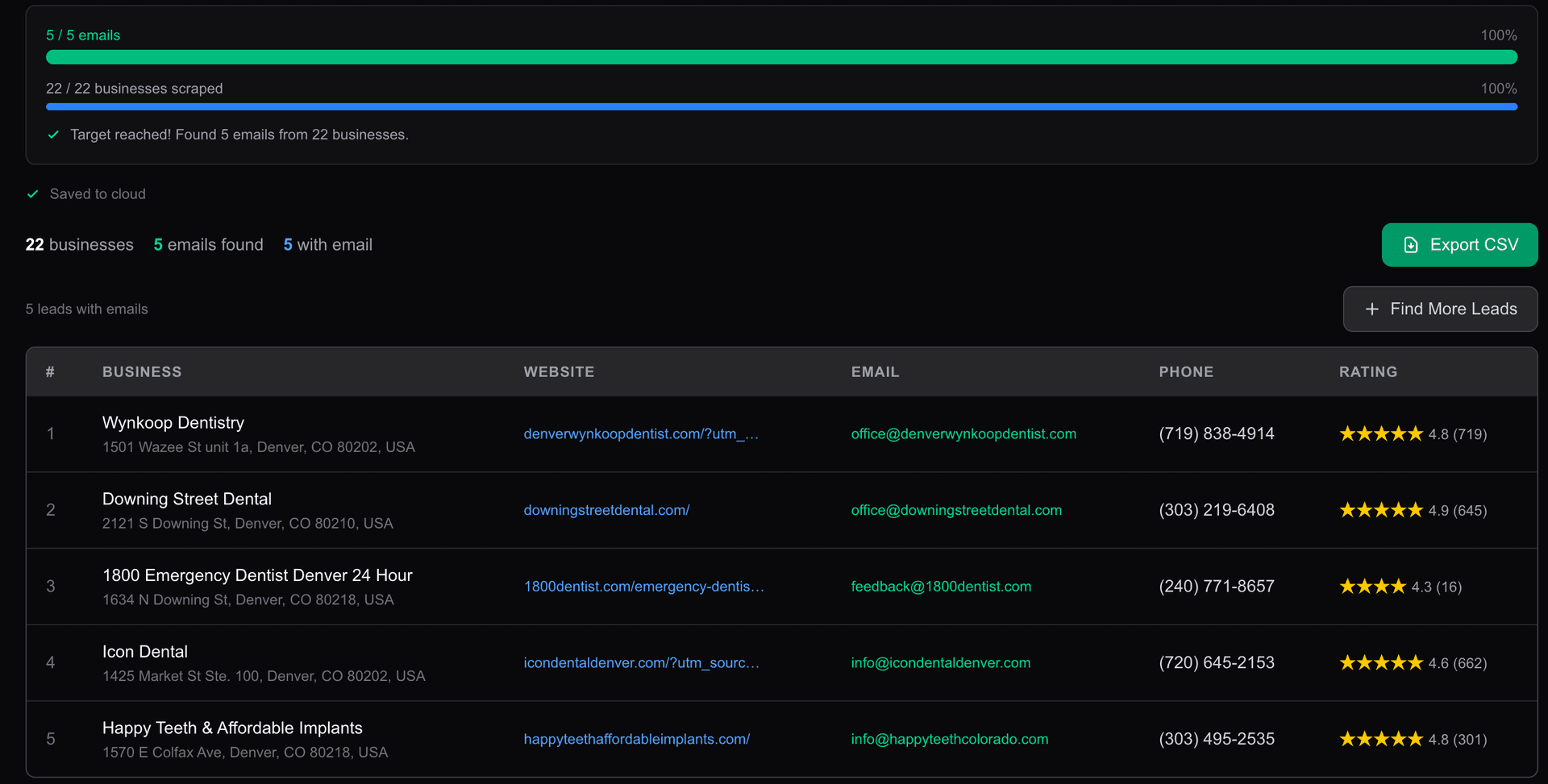
You search for a business type and location, and get structured results with emails, phones, addresses, websites, and review data. The pay-per-lead pricing means you often spend less than direct API usage because the service handles the expensive detail requests efficiently.
Scraping Google Maps directly (Options 1 and 2) violates Google's Terms of Service and carries legal risk. While enforcement varies, businesses have faced legal action. If compliance matters to your business, use the official API (Option 3) or a compliant tool like Easy Email Finder (Option 4).
For most businesses, Easy Email Finder offers the best combination of data quality, legal compliance, ease of use, and cost-effectiveness. If you have developers on staff and need custom integrations, the Google Places API directly is also excellent. Avoid DIY scraping unless you fully understand and accept the legal and maintenance risks.
Getting Started the Right Way
If you are new to Google Maps data extraction, start with Easy Email Finder's 25 free credits. Test the data quality for your specific use case. If you need more customization or volume, consider the Google Places API directly. Either way, stay on the right side of Google's terms.
Ready to find business emails?
Try Easy Email Finder free, get 5 credits to start.
Start Finding Emails